
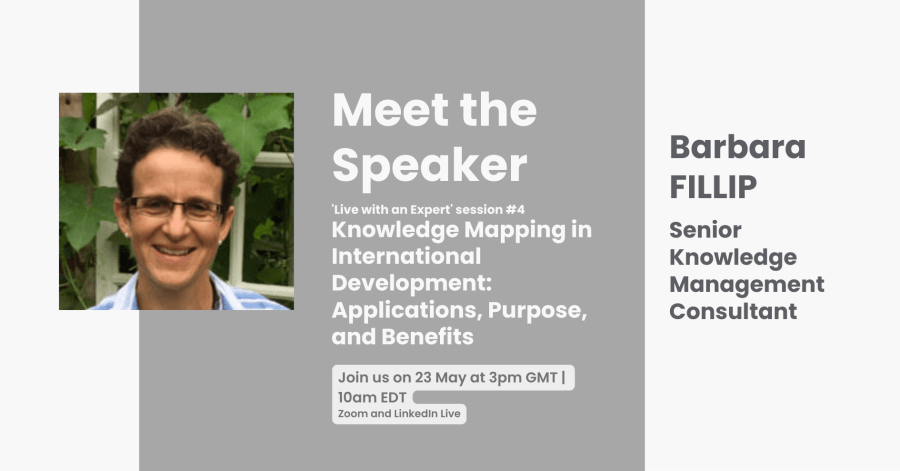
Barbara Fillip is a senior Knowledge Management Consultant based in Washington, DC. Barbara spent the past two decades supporting individual, team, project, and organisation-wide learning in two industries, namely international development and aerospace. She has worked as a consultant and led knowledge management at a global development agency. Barbara teaches graduate courses in knowledge management and collaboration in the Schar School of Policy and Government at George Mason University’s Master’s in Organization Development and Knowledge Management program. She holds a PhD in international affairs from the University of Pittsburgh Graduate School of Public and International Affairs.
We sat down with Barbara for a short interview to learn more about her experience in KM and the sector. Follow our conversation below.
Hi Barbara, thank you for taking the time to share your experience and insights with us today. You are a very active “KMer” and have worked in this field for over two decades. You also teach KM to graduate students. Tell us what attracted you to KM in the first place?
“I started my career more focused on monitoring and evaluation, before the “L” was added to become MEL and integrate “learning”. But I was more interested in the process of learning from the very beginning and the way we could articulate and then leverage lessons learned. That’s how I got hooked on KM.”
What trends or changes have you observed in KM generally throughout your career?
“What’s been consistent is perhaps more relevant. Obviously, the technologies change, but we seem to repeat the same missteps with technology. We see a lot of potential and we end up spending a lot of time and energy investing in KM systems perhaps at the expense of the basics. We forget the four pillars of KM: People, process, technology, and governance. I’ve adjusted a lot of my perspectives over the years, but if there’s one thing I’ve been obstinate about it’s the need to pay attention to all four pillars for a robust KM framework. I’m as excited as the next person about Artificial Intelligence and its applications to Knowledge Management, but it needs to happen within the broader context of a robust KM framework.”
The webinar is about knowledge mapping – why this topic? How relevant do you think knowledge maps are in the development sector, or any sector, today?
“It depends on how we define knowledge mapping. I use the term broadly to refer to visual representations of knowledge. I’ve been heavily influenced in my thinking by concept mapping, which is a method I’ve learned and applied extensively during my days at NASA. I was doing a lot of mapping to document Pause and Learn sessions. These types of sessions are often referred to as After-Action-Reviews (AARs) or Pause and Reflect in a USAID context for example. I’ve used mapping in many different ways and I’ve always found it a great thinking tool because it allows you to see relationships and connections where a more traditional linear narrative doesn’t reflect those connections as intuitively.”
Have you applied knowledge maps recently? What was the context and process?
“I am taking my personal knowledge management practice to another level by attempting to create a personal knowledge graph. I started with what looks like a simple mind map of key themes and topics I want to explore throughout 2024 and as I add notes, I tag them and create links. This is ultimately going to generate a big knowledge graph, which is essentially a concept map on steroid.”
What about challenges which you experienced in applying knowledge maps, if any? And what conclusions or lessons were drawn from your experiences?
“When I was producing a large number of individual knowledge maps for Pause and Learn sessions, I started aggregating them into a web of maps, connecting them and extracting key insights around specific themes. The process was very manual and ultimately it was not very scalable given the tools I was using. The tools are evolving quickly and knowledge graphs can now handle very large volumes of data if the proper ontologies are established. Combining human insights with technology, including knowledge graphs and Artificial Intelligence could allow us to draw out many more useful insights from knowledge assets. We just have to be careful to position technology options and advances in the broader context of a KM framework.”
What advice would you give to anyone who is new to knowledge mapping? Where does one start?
“I would recommend starting small with a personal knowledge management approach. It might even be a good idea to start with mind maps and then increase the complexity and utility of the mapping to discover how they can be used as thinking tools. Once you’ve personally experienced some of the benefits, it’s easier to convince a small team to document a Pause and Reflect session or any relevant meeting as a map. Generative AI is not very good at generating concept maps yet. This is an area where human insight and understanding still prevail.
In fact, I am now recommending to the graduate students in my KM class to start by examining their own Personal Knowledge Management habits before trying to tackle things like team learning or organization-wide KM systems.”
Any other tips or important points to take into consideration?
“Just to be coherent and circle back to the key point I was trying to make about the need for a robust KM framework, it would be good to consider where knowledge mapping might fit in: A very high level knowledge map in an organization, based on strategic objectives would provide necessary focus for KM activities and the types of processes to put in place. Knowledge mapping could also support the identification of knowledge gaps and guide the development of knowledge retention and knowledge acquisition (people). A knowledge map could identify the existing systems and tools that people are using to create, store, and share knowledge, potentially pointing to possible improvements (technology). Last but not least, the governance around KM could make the development and regular update of knowledge maps a requirement as part of an annual work planning process. That’s probably a dream of mine!”
Thank you so much Barbara, it has been a pleasure talking with you and we really appreciate your insights. See you at the event!
Learn more from Barbara during our fourth ‘Live with an Expert’ session or Knowledge Mapping in International Development on 23 May 2024 at 3pm GMT | 10am EDT.
 Consult KM International